











True Zero-Touch Industrial Deployment Starts with Architecture, Not Automation
Why cloud-first management and distributed edge execution are essential for scaling Industrial Data Management.
Connecting one industrial gateway is relatively straightforward. Deploying the same solution across dozens of factories, hundreds of machines, and different geographical locations is a completely different challenge.
The complexity is rarely limited to installing software or establishing connectivity.
It comes from managing configurations, maintaining consistency, deploying changes, recovering from failures, and ensuring that industrial data continues to follow the same structures as systems evolve.
This is where the concept of Zero-Touch Deployment becomes particularly relevant.
But there is an important distinction.
Zero-Touch is not simply about deploying software remotely.
It is about removing the need to repeatedly engineer, configure, and maintain each industrial installation independently.
And achieving that requires the right architecture.
The Problem with Device-Centric Architectures
Traditional industrial edge solutions often follow a device-centric model.
Each gateway contains its own configurations, connectivity settings, processing logic, and application integrations.
Even when remote management is available, the deployment process may still depend on configuring individual devices, maintaining local project files, or executing scripts across different installations.
This approach can work for a limited number of gateways.
The problems become more apparent as deployments grow:
- Configuration differences emerge between factories.
- Updates require repeated work across installations.
- Troubleshooting depends on understanding individual device configurations.
- Hardware replacements may require rebuilding local environments.
- Data structures and transformations gradually become inconsistent.
Remote access does not necessarily solve these problems.
Being able to connect to a gateway remotely and modify its configuration is useful, but it does not eliminate distributed configuration management.
Remote configuration is not the same as centralized engineering.
This distinction becomes fundamental when industrial organizations need to scale.
Cloud-First Management. Local Edge Execution.
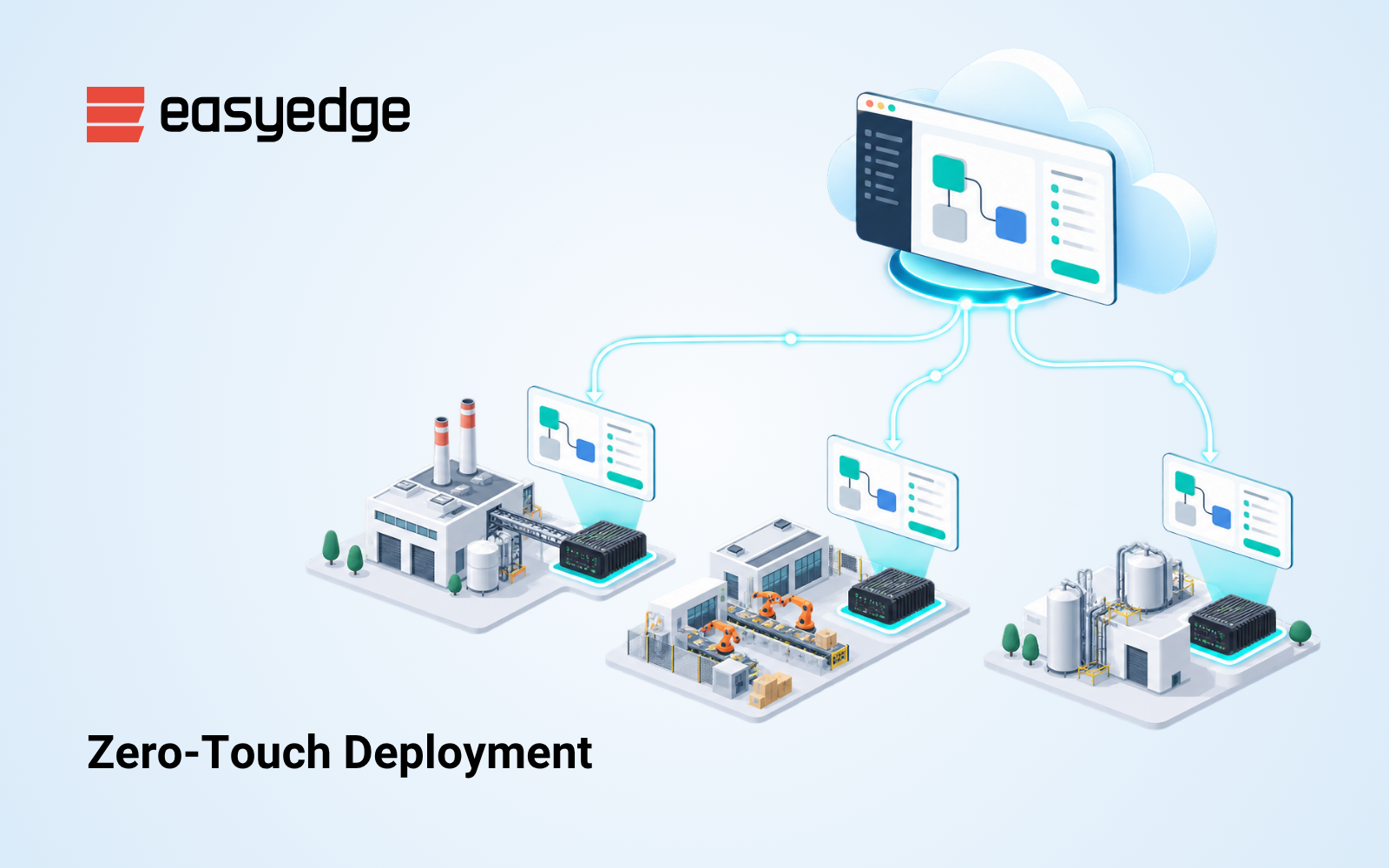
At EasyEdge, we approached this challenge by separating two responsibilities that are often combined: the management of industrial data infrastructure and the execution of industrial data operations.
The EasyEdge Platform is built around two complementary components.
EasyEdge Studio: Centralized Engineering and Governance
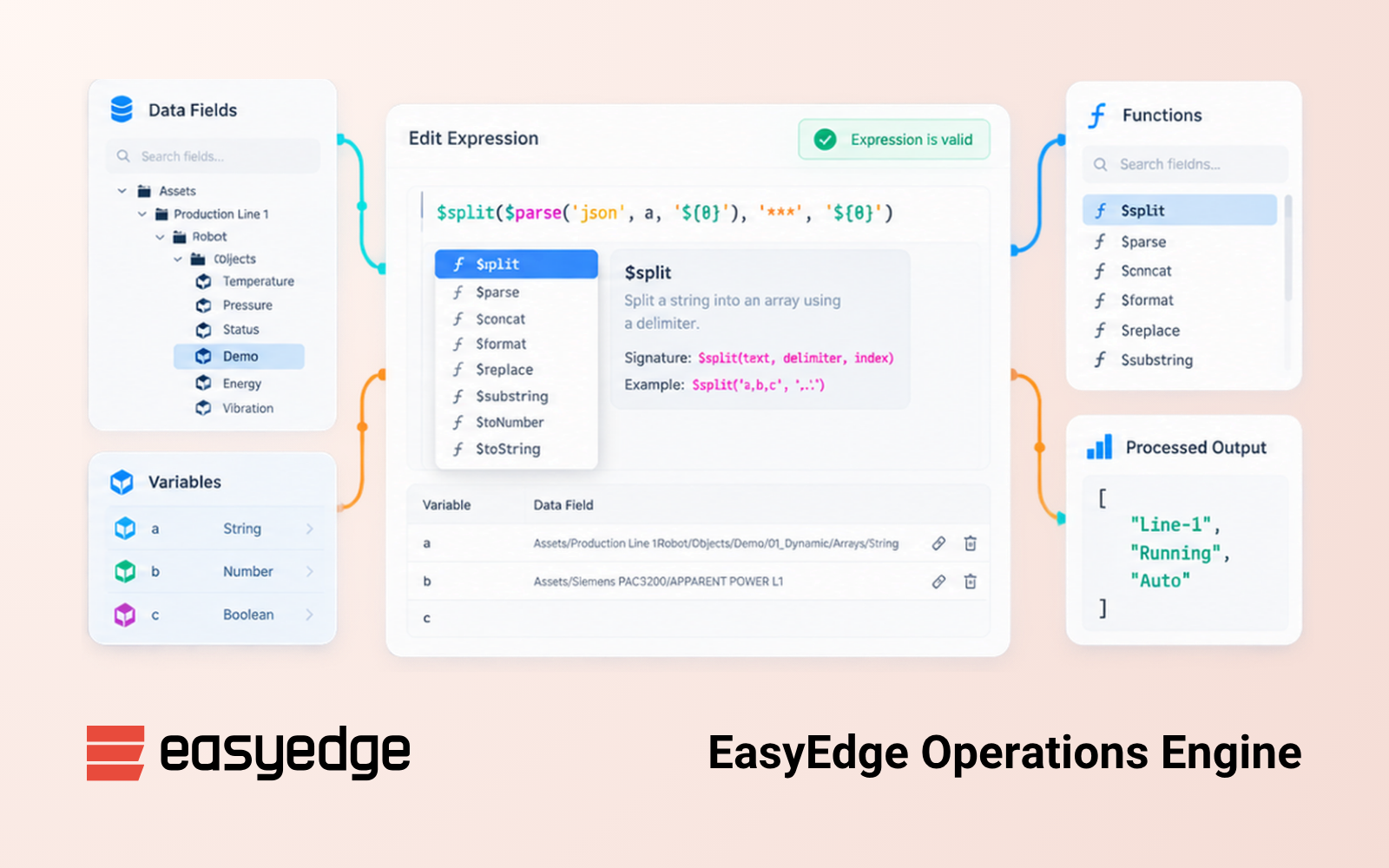
EasyEdge Studio provides a cloud-first environment for engineering, configuring, governing, deploying, and monitoring industrial data infrastructure across distributed locations.
Instead of treating every gateway as an independent project, organizations can manage reusable configurations, industrial Asset Profiles, Mappings, Data Models, and deployments centrally.
This enables engineering teams to define how industrial data should be acquired, structured, transformed, and delivered without repeating the entire configuration process for every installation.
Changes can be managed from a common environment, with controlled versioning and visibility across distributed deployments.
EasyEdge Node: Distributed Industrial Execution
EasyEdge Nodes execute these configurations locally, close to industrial equipment and systems.
They provide industrial connectivity, data acquisition, processing, transformation, and delivery to consuming applications and platforms.
This separation is essential.
Cloud-first does not mean cloud-dependent execution.
Industrial data operations need to remain close to the equipment. Network constraints, latency, availability, and operational requirements make local execution important.
The cloud provides centralized engineering and management, while the edge provides distributed execution.
This allows organizations to combine global consistency with local operational requirements.
Zero-Touch Is a Lifecycle, Not an Installation Event
Many Zero-Touch discussions focus almost exclusively on initial device provisioning.
But industrial infrastructure must operate for years, often across multiple generations of equipment and hardware.
A truly scalable approach must address the complete deployment lifecycle.
1. Prepare and Deploy
Once the necessary edge infrastructure, connectivity, and access are available, configurations can be prepared centrally and deployed to the relevant EasyEdge Nodes.
The engineering process is not tied to a particular gateway.
This reduces the need to configure each installation independently.
2. Reuse and Scale
Industrial assets often share common characteristics, even when installed in different factories.
Reusable Asset Profiles, Mappings, and Data Models allow organizations to standardize configurations and apply them across multiple deployments.
Rather than starting from scratch at every new site, teams can reuse approved engineering structures and adapt only what is specific to the installation.
3. Maintain and Evolve
Industrial systems change.
New equipment is installed, data requirements evolve, and consuming applications introduce new expectations.
With EasyEdge Studio, configurations and their versions can be managed centrally, allowing teams to control how changes are introduced across distributed Nodes.
This reduces configuration drift and makes ongoing maintenance more predictable.
4. Observe and Recover
Distributed infrastructure also requires operational visibility.
EasyEdge provides centralized monitoring of Nodes, deployment status, and operational information, helping teams identify issues without depending entirely on local intervention.
When gateway hardware fails, EasyEdge Smart EdgeNode Recovery allows centrally managed configurations to be restored on replacement hardware.
The physical device may still require installation and validation, but the industrial data configuration does not need to be reconstructed from scratch.
That is an important practical distinction between automating installation tasks and designing infrastructure for repeatable recovery.
Why Industrial Data Governance Makes Zero-Touch More Valuable
There is another dimension that is frequently overlooked.
Deploying the same software everywhere does not guarantee consistent industrial data.
Consider an organization collecting energy information from different types of meters across multiple factories.
The equipment may use different communication protocols, expose different source data structures, or represent measurements using different units.
Simply connecting these devices and publishing their values does not create a consistent industrial data foundation.
This is where Industrial Data Governance becomes part of the deployment architecture.
EasyEdge allows organizations to manage the relationships between source structures, Mappings, and target Data Models.
For example:
- Asset Profiles define reusable source data structures.
- Mappings relate, transform, and contextualize industrial information.
- Data Models define consistent structures for consuming applications.
By governing these relationships, organizations can reuse established engineering logic and manage changes without manually rebuilding every consuming data structure.
This extends the value of centralized management beyond device configuration.
It means that new deployments can inherit not only connectivity settings but also the data structures and transformation logic required by the business.
The objective is not just to deploy the same configuration.
It is to deliver the same governed data structures consistently.
For Industrial Data Management, this is where centralized governance and distributed execution become particularly powerful.
The Operational Difference Becomes Visible at Scale
The real value of an architecture is rarely demonstrated by its first deployment.
Almost any industrial connectivity solution can be configured to collect data from a machine.
The difference becomes clear when organizations need to repeat that deployment across many machines, gateways, factories, and geographical regions.
In a device-centric architecture, each new installation can introduce additional configuration, maintenance, and support responsibilities.
In a centrally managed architecture, reusable engineering and governed structures reduce the work that must be repeated.
This changes the operational model.
Instead of asking how quickly a single gateway can be configured, organizations can focus on more meaningful questions:
- How much engineering must be repeated at the next factory?
- How consistently can approved configurations be deployed?
- How are changes governed across existing installations?
- How quickly can infrastructure be recovered after hardware failure?
- How can industrial data remain consistent as sources and applications evolve?
These are the questions that determine whether an Industrial Data Management platform can scale effectively.
Time-to-first-data validates the integration.
Time-to-next-site validates the architecture.
Conclusion: Engineer Centrally. Govern Globally. Execute Locally.
Zero-Touch Deployment should not be measured solely by how few interactions are required to install a gateway.
In industrial environments, physical installation, network preparation, equipment access, and operational validation will still require attention.
The objective is to eliminate unnecessary repetition of engineering work and reduce dependence on device-specific configuration.
This requires an architecture where configurations are centrally managed, industrial data structures are governed, and execution remains distributed.
That is the approach behind EasyEdge.
EasyEdge Studio provides centralized engineering, governance, deployment management, and visibility.
EasyEdge Nodes execute industrial connectivity and data operations locally.
Together, they allow organizations to build reusable industrial data infrastructure that can be consistently deployed, maintained, and evolved across distributed operations.
Connecting the first machine proves that the technology works.
Scaling consistently across factories proves that the architecture works.
And that is what true Zero-Touch Industrial Deployment should ultimately deliver.
Engineer centrally. Govern globally. Execute locally.