














EasyEdge Operations Engine: Unlocking the Power of Edge Data Processing with Expressions
Discover how EasyEdge Operations Engine transforms and normalizes industrial data at the edge using reusable Expressions, mathematical functions, and the built-in Expression Assistant.
Why Edge Data Processing Matters
Industrial systems generate enormous amounts of data every second, from sensors, PLCs, meters, machines, and other connected equipment.
Sending every raw signal directly to the cloud is not always practical. It can increase bandwidth consumption, introduce unnecessary latency, and add complexity to downstream applications. More importantly, raw industrial data often lacks the context, consistency, and quality required for meaningful analytics.
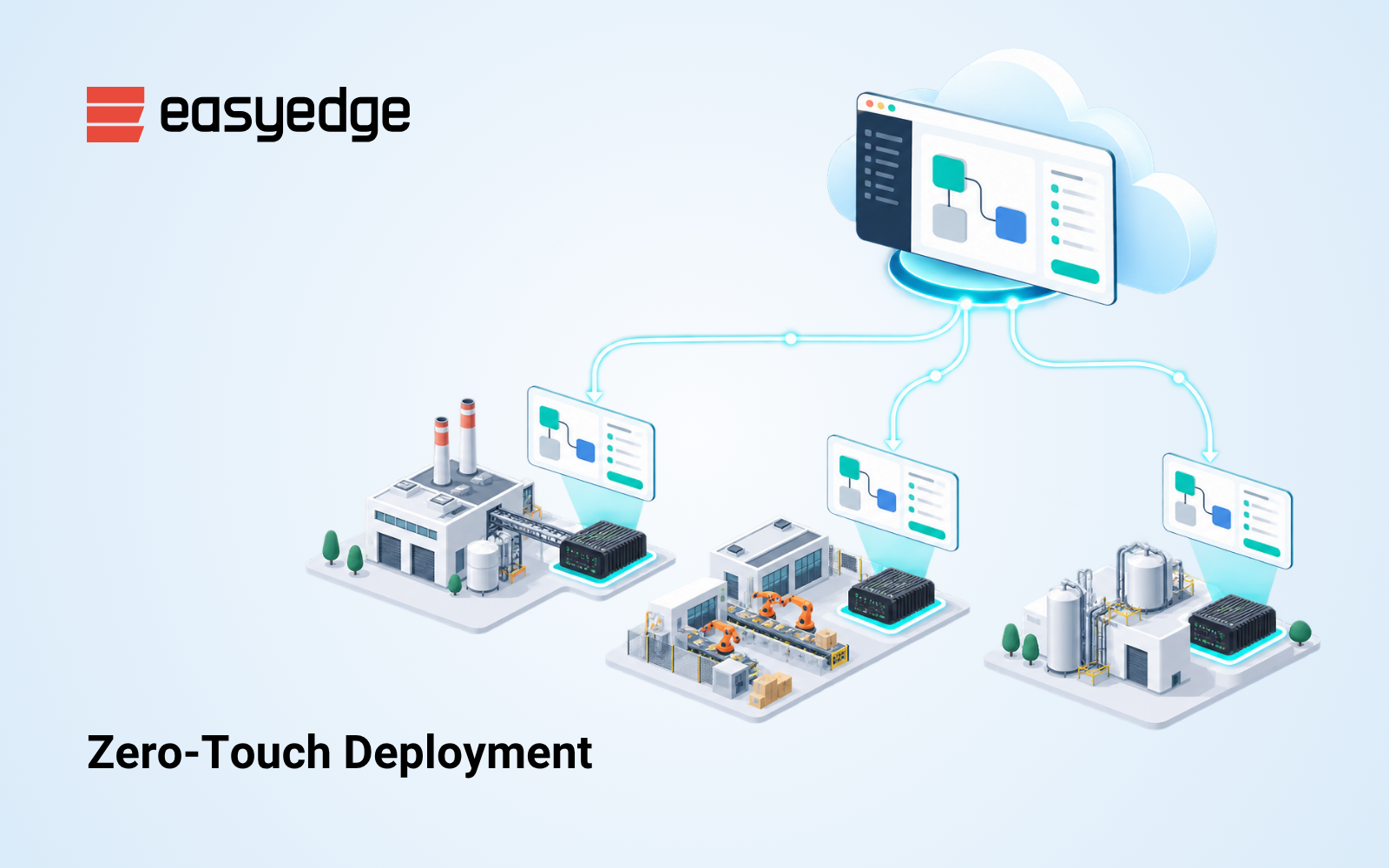
Edge Data Processing addresses these challenges by bringing data transformation and processing closer to the source.
By filtering, calculating, normalizing, and enriching industrial data locally, organizations can reduce unnecessary data transmission and deliver more useful information to enterprise applications in real time.
This is where the EasyEdge Operations Engine plays an important role: providing a flexible framework for designing and executing industrial data operations directly at the edge.
How the EasyEdge Operations Engine Works
At the core of EasyEdge is the Operations Engine, a framework designed to execute data transformations, calculations, and logic operations in real time.
Its capabilities are built around Expressions, mathematical operators, and dynamic functions, which can be combined to create processing logic before industrial data is delivered to applications or cloud platforms.
Rather than requiring custom software development for every transformation, the Operations Engine allows engineers to define processing logic through reusable expressions.
1. Expressions as the Building Blocks
Expressions define how industrial data should be interpreted, calculated, transformed, or formatted.
They can perform straightforward operations, such as converting a temperature from Celsius to Fahrenheit, or more complex calculations involving several input variables.
This flexibility allows engineers to build data processing logic that reflects the specific requirements of their industrial environment.
2. Mathematical Expressions
The Operations Engine supports mathematical operators ranging from basic arithmetic, including addition, subtraction, multiplication, and division, to more advanced functions such as logarithms and trigonometric calculations.
These capabilities allow engineering formulas and calculated values to be processed locally, without requiring additional programming or external calculation services.
For example, an expression can calculate efficiency ratios using multiple equipment measurements or convert raw sensor values into engineering units.
3. Dynamic Functions for Context-Aware Data
Industrial data processing frequently involves more than numerical calculations.
Dynamic functions allow engineers to extract, manipulate, and format information from structured data, timestamps, and text values.
Functions such as $parse, $substring, and $datetime support operations including:
- Extracting information from structured payloads.
- Parsing and manipulating JSON data.
- Processing text and identifiers.
- Formatting or adjusting timestamps.
- Preparing data for downstream consumption.
These capabilities are particularly useful when integrating heterogeneous industrial systems that provide information in different formats.
4. Combining Expressions and Functions
The real flexibility of the Operations Engine comes from combining multiple expressions and functions into a single processing sequence.
For example, an engineer can extract a value from a JSON payload, perform a mathematical calculation, and apply conditional formatting within the same expression chain.
This makes it possible to build processing logic tailored to individual assets, applications, and operational requirements.
5. Nested Expressions for Complex Scenarios
Expressions can also be nested, allowing the result of one operation to become the input of another.
This enables more sophisticated processing logic without requiring a separate programming workflow for each individual operation.
Nested expressions are useful for calculations involving several variables, conditional transformations, anomaly-related logic, and other complex industrial data processing scenarios.
Practical Use Cases for Industrial Edge Processing
The combination of mathematical expressions, dynamic functions, and nested operations enables a wide variety of industrial applications.
Examples include:
- Data normalization: Convert values from equipment supplied by different manufacturers into a standardized format.
- Engineering unit conversion: Convert measurements such as watts to kilowatts, kilopascals to bar, or Celsius to Fahrenheit before data leaves the factory.
- Payload processing: Extract relevant information from JSON messages, reducing the amount of data transmitted to downstream systems.
- Calculated operational indicators: Combine equipment measurements to generate efficiency ratios, performance metrics, and inputs for KPIs such as Overall Equipment Effectiveness (OEE).
- Data preparation: Apply transformations and formatting rules before delivering information to MES, ERP, cloud platforms, or analytics applications.
By executing these operations close to industrial equipment, EasyEdge helps organizations deliver more consistent and meaningful data while reducing the processing burden on downstream systems.
Expressions: Delivering the Full Power of the Operations Engine
Expressions provide the interface through which engineers configure the processing capabilities of the EasyEdge Operations Engine.
Instead of writing extensive custom code, users can define calculations, transformations, and processing rules directly within their EasyEdge configurations.
This approach makes advanced data operations more accessible while giving engineers control over how industrial data is prepared and delivered.
Tag-Level vs Data Stream-Level Processing
One of the key advantages of EasyEdge is the flexibility to apply Expressions at different points in the data processing flow.
Users can define operations at the Asset Tag level, transforming individual values close to their source, or at the Data Stream level, applying transformations to data prepared for downstream consumption.
This allows the same original measurement to be used differently depending on the application's requirements.
For example, a power meter may provide measurements in watts.
An engineer can apply an Expression at the Tag level to convert those measurements into kilowatts. Alternatively, the original value can remain available as a Tag while a Data Stream applies the conversion before delivering information to a particular application.
This separation gives teams more flexibility when different applications require different representations of the same industrial data.
On-the-Fly Transformations
Expressions enable industrial data to be processed as it is acquired, without requiring every transformation to be performed in a cloud platform or external application.
A simple Expression can convert sensor readings, apply multipliers, normalize values, or prepare data for downstream systems.
For example:
- Convert watts to kilowatts directly at the Tag level.
- Preserve the original reading while applying a conversion at the Data Stream level.
- Apply mathematical calculations using multiple input measurements.
- Extract selected information from structured messages before forwarding it.
These operations can be executed locally by EasyEdge Nodes, keeping data processing close to industrial equipment.
Consistency Across Applications
Industrial organizations frequently use multiple applications that require access to the same operational data.
When every application performs its own transformations, inconsistencies can emerge in calculations, units, and data formats.
By performing transformations at the edge, EasyEdge allows processed information to be shared with applications such as MES, ERP, cloud analytics, and industrial monitoring platforms.
This reduces the need to reproduce the same data processing logic independently in every consuming system.
Scalable Engineering
Reusable Expressions also help simplify engineering across multiple assets, equipment types, and gateway deployments.
Once processing logic has been defined and validated, it can be applied to similar configurations instead of being recreated manually for each installation.
This helps reduce repetitive work, improves consistency, and supports more efficient project deployment and maintenance.
EasyEdge Expression Assistant: Simplifying Project Engineering
Building industrial data processing logic can become challenging when projects involve hundreds of Tags, multiple transformation layers, and complex calculations.
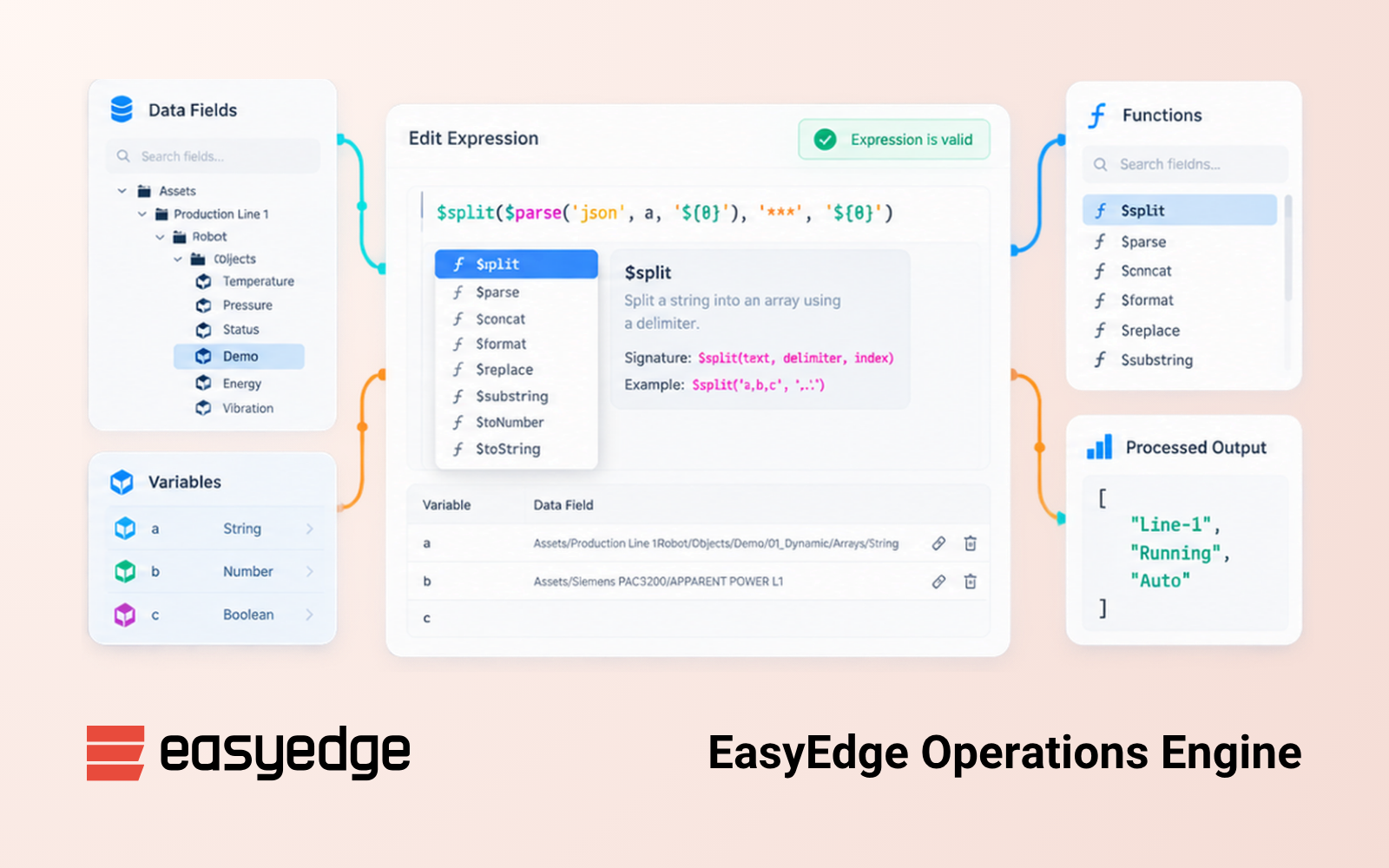
The EasyEdge Expression Assistant was designed to simplify this engineering process by providing contextual assistance directly within the Expression workspace.
As engineers create or modify Expressions, the assistant provides guidance on available functions, variables, and syntax.
This reduces the need to consult external documentation repeatedly and helps users construct processing logic more efficiently.
Contextual Suggestions and Autocomplete
The Expression Assistant suggests available functions and variables as users type.
Instead of remembering every function name or manually searching through configured variables, engineers can explore the available options directly within the editor.
This is particularly useful when working with expressions that reference multiple data sources or use combinations of mathematical and dynamic functions.
Syntax Validation and Error Prevention
The assistant also provides feedback on Expression syntax, helping users identify errors while configuring their processing logic.
By highlighting potential syntax issues during editing, engineers can resolve problems earlier in the configuration process.
This improves the engineering experience and reduces the amount of manual troubleshooting required before deployment.
Building Complex Expressions with Greater Confidence
Autocomplete, syntax validation, and contextual suggestions become especially valuable when creating nested Expressions or combining multiple functions.
Engineers can progressively construct their logic, inspect available operations, and correct syntax issues within the same workspace.
The result is a more structured and accessible approach to industrial data transformation.
By combining visual assistance, syntax validation, and contextual guidance, the EasyEdge Expression Assistant helps engineers concentrate on data processing requirements rather than repeatedly checking syntax or function definitions.
Making Industrial Data More Useful at the Edge
Industrial connectivity is only the first step in making operational data valuable.
Once data has been acquired, it often needs to be transformed, calculated, normalized, and prepared before applications can use it effectively.
The EasyEdge Operations Engine provides the processing capabilities required to perform these operations locally, while Expressions give engineers a flexible way to define how industrial data should be handled.
Combined with the Expression Assistant, this approach simplifies the development of industrial data processing logic and supports more consistent engineering across connected systems.
Connect industrial data. Process it at the edge. Deliver information that applications can use.